
News
Date:2025-09-14
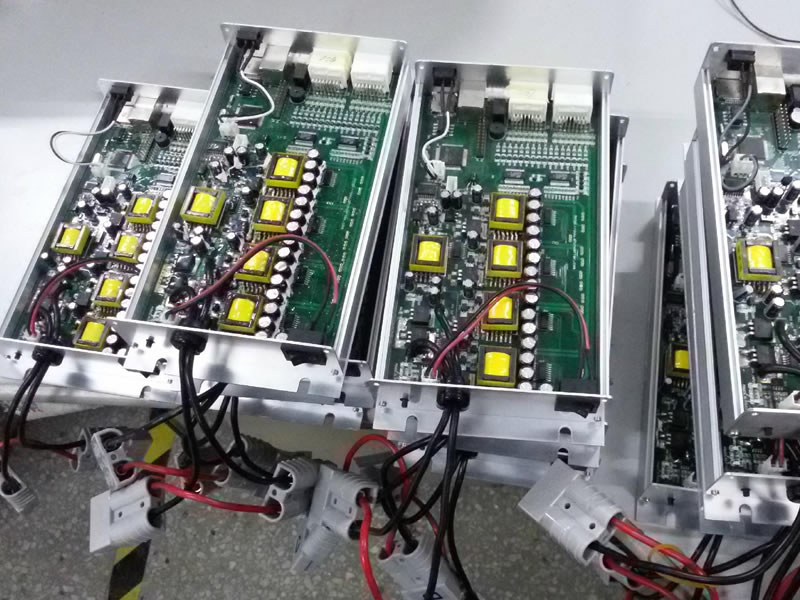
1、 What is BMS
BMS stands for Battery Management System. It is a device that cooperates with monitoring the status of energy storage batteries. Generally, BMS is represented as a circuit board or a hardware box.
1. Real time monitoring
Voltage monitoring: detecting the total voltage and the voltage of each cell or module;
Current detection: measure the total current of charging and discharging;
Temperature monitoring: By installing temperature sensors, detect temperature changes at various nodes inside the battery pack;
2. State estimation
SOC (State of Charge) estimation of remaining battery capacity: using ampere hour integration method and open circuit voltage method to estimate the remaining battery capacity of the battery pack
State of Health (SOH) estimation of health status: By analyzing the internal resistance growth, full charge capacity decay, and number of charge discharge cycles of the battery, a comprehensive estimation is made to reflect the degree of aging of the battery
SOP (State of Power) estimates available power: estimates the maximum discharge power and maximum charging power that a battery can provide in a short period of time (such as a few seconds or tens of seconds).
SOE (State of Energy) estimates remaining energy: estimates the current available energy (in kWh) of the battery, which is more direct for predicting range.
3. Protection - Security Management
When an abnormal or dangerous state is detected, the BMS will take immediate action to cut off the power supply
Overvoltage protection: When the voltage of any battery cell exceeds the safe upper limit, the charging circuit is cut off to prevent overcharging.
Undervoltage protection: When the voltage of any battery cell falls below the safe lower limit, the discharge circuit is cut off to prevent over discharge.
Overcurrent protection: When the charging or discharging current is too high, the circuit is cut off to prevent short circuit or overload.
Over temperature protection: When the battery temperature exceeds the safe threshold, reduce power or cut off the circuit.
Short circuit protection: In the event of a serious short circuit, cut off the circuit at the fastest speed (microsecond level).
Insulation monitoring: Monitor the insulation resistance between the high-voltage system and the vehicle chassis to prevent leakage risks.
Fault diagnosis and recording: BMS will record all fault information, form fault codes, and provide a basis for subsequent maintenance.
4. Control the balancing circuit to maintain consistent power levels among all energy-saving cells and extend their lifespan;
5. Timestamp key events and store them in flash memory for fault tracing and warranty analysis.
2、 Why is RTC installed in BMS - taking YSN8563MS as an example
The BMS equipped with RTC (real-time clock chip, such as the common YSN8563) has only one core purpose: to enable the system to have absolute, traceable, and low-power "time coordinates" even in the "power-off sleep" state.
(1) Sleep timed wake-up - turn "normal standby" into "intermittent physical examination"
After the vehicle is turned off, the main MCU loses power, and the RTC runs on button batteries with a current of 0.3-0.5 µ A; At the preset time (such as every 4 hours, 2 am every day), output an interrupt signal to wake up the BMS from Deep Sleep and perform cell voltage/temperature inspection.
(2) SOC static correction
The ampere hour integral method will drift for a long time and must be returned to positive using the open circuit voltage method; The open circuit voltage method requires the battery to be idle for at least 2 hours and to know the "actual idle time". RTC continuously counts, and after the system restarts, it will compare the last shutdown time to calculate the actual idle time. When the idle time is ≥ 2 hours, the open circuit voltage method will be triggered, and after completion, it will sleep again, which is both energy-saving and not missed.
(3) Accurate timing of faults
The national standard GB 38031-2020 and accident identification require key events to have a timestamp with an accuracy of 1 second. RTC provides absolute calendar time for fault codes (DTC), overcharging, overdischarging, thermal runaway logs, and EDR collision records when the system is powered off, to avoid evidence of "only serial number, no time" being invalidated.
(4) Temperature sampling and time marking
High temperature calendar aging and cyclic aging are closely related to temperature and time. RTC can accurately mark the time scale in temperature sampling, allowing BMS to accumulate high temperature exposure time, cycle times/intervals, dynamically adjust the maximum charging current, warn SOH drops, and enhance quality assurance confidence.
3、 Why is RTC installed separately instead of the MCU's built-in RTC?
Higher accuracy: Specialized RTC chips typically have an external 32.768kHz crystal oscillator, which has much higher time accuracy than most MCUs with built-in RTC.
Lower power consumption: In sleep mode, the power consumption of dedicated RTC can reach microampere level or even nanoampere level, which is lower than the overall sleep power consumption of MCU, and supports BMS long-term sleep.
More reliable: independent chip, not affected by MCU main program running or resetting, even if the vehicle system restarts, time information will not be lost (with backup battery or supercapacitor power supply).
Function integration: The RTC clock chip integrates functions such as timer, alarm, clock output, and precise timestamp, providing convenience and accurate fault location for system design.


 Language
 Your location:



 Follow us
 0755-83865780
  E-mail