
News
Date:2025-11-24
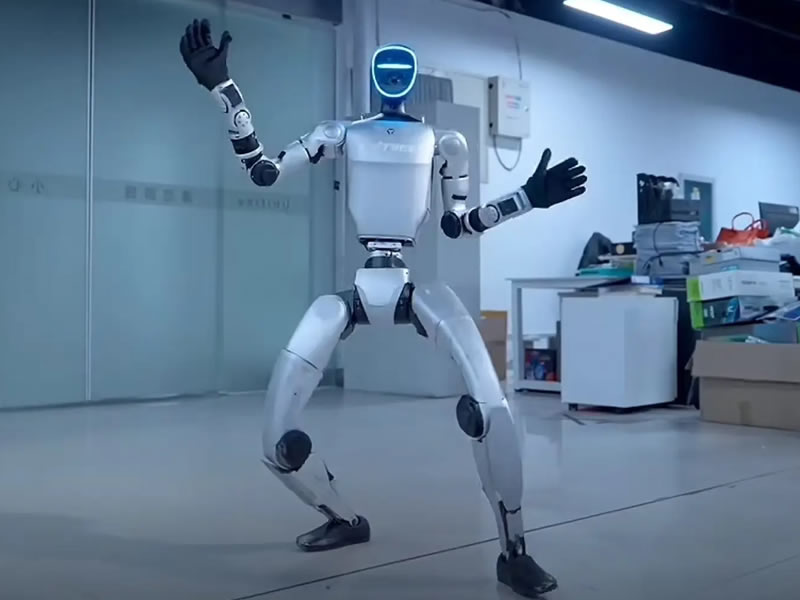
From August 14th to 17th, 2025, the world's first comprehensive sports event featuring humanoid robots as the main participants, the "2025 World Humanoid Robot Games," will be held grandly at the National Speed Skating Oval in Beijing. During the sports meet, robots completed high difficulty projects such as running competitions, football matches, and Chinese martial arts performances with amazing coordination and fluency, which was amazing!
Behind this series of smooth movements, the important role of robot communication systems is indispensable. The communication system of robots is like the neural network of the human body, which can transmit signals to various parts of the robot, enabling the robot to strictly operate corresponding instructions.
Entering the communication world of humanoid robots
Imagine if a robot only has sensors and drivers, but no communication system receives sensor signals and sends instructions to the drivers, then the robotic arm cannot function properly. The robot communication system is a key component for robots to achieve information exchange and collaborative work. It uses information and communication technology to achieve information transmission and control between internal modules of robots, as well as between robots and external devices and environments. Generally speaking, the communication system of humanoid robots can be divided into two major systems: internal communication and external communication.
Internal communication: Technologies such as CAN bus, FlexRay bus, and industrial Ethernet are commonly used to tightly connect the robot brain with various components, ensuring coordination and efficiency between internal modules of the robot. Humanoid robots coordinate the movements of various joints through an internal communication system to complete actions such as walking and grasping.
External communication: It mainly achieves information exchange between robots and controllers or multiple robots through wireless communication technology and cloud interaction systems, serving as a bridge for robots to interact with the world. Such as robots executing tasks according to instructions, robot group collaborative performances, etc.
Crystal oscillator requirements for robot communication
The communication of robots requires extremely high real-time, smoothness, and reliability. Even a small instruction delay or one bit of data error can lead to joint loss of control, collaboration disorder, or even task failure. The completion of real-time, smoothness, and reliability in robot communication relies on a seemingly small but crucial component - the crystal oscillator. Crystal oscillator is the core component of robot communication system, and its performance directly affects the communication efficiency, stability, and reliability level of the robot.
Crystal oscillators play a crucial role in robot communication systems, mainly reflected in the following aspects:
Provide stable clock signal: The crystal oscillator generates a stable frequency signal through periodic vibration, which can provide accurate clock reference for robot communication modules such as Wi Fi, Bluetooth, 5G, etc. Common frequencies include 40MHz, 26MHz, and 24MHz.
Ensuring low latency and high reliability transmission of data: The phase noise and jitter control capability of crystal oscillators directly affect the speed and anti-interference performance of robot communication. A crystal oscillator with low jitter and high stability can reduce signal transmission delay, improve communication quality, avoid data delay or loss, and ensure stable communication of robots in complex environments.
Ensure multi node time synchronization: In robots, modules such as the main control chip, sensors, motion control, and communication system need to work together. The unified clock signal provided by the crystal oscillator can ensure time synchronization between various modules, enabling precise matching of sensor data acquisition, main control chip receiving and processing data, motion control instruction execution, and other links, achieving millisecond or even microsecond level collaboration, and avoiding system failures caused by timing errors.
Xintu Technology provides you with a crystal oscillator selection guide for robot communication!
The communication system of robots requires crystal oscillator characteristics, including high-precision frequency stability, low phase noise and jitter, wide temperature range adaptability, miniaturization, and low power consumption.
The stability of crystal oscillator frequency directly affects the synchronization and transmission quality of communication signals, generally requiring ± 10PPM and ± 20PPM.
Crystal oscillator phase noise and jitter can affect the clarity and anti-interference ability of communication signals. Low jitter crystal oscillators can reduce signal distortion, improve communication reliability and transmission speed.
Crystal oscillators need to have the ability to operate over a wide range of temperatures, such as working normally within the temperature range of -40 ℃ to 85 ℃. In extreme temperature environments, temperature compensated crystal oscillators can also be used to ensure frequency stability.
Miniaturization of packaged crystal oscillators helps to achieve more flexible joint design, which is beneficial for improving robot motion flexibility and response speed.
Robots typically rely on battery power, and low-power crystal oscillators can extend battery life and reduce costs.
It is recommended to prioritize surface mount (SMD) crystal oscillators, which have stronger resistance to vibration and impact than traditional direct insertion (DIP) crystal oscillators.
The communication system has very strict requirements for crystal oscillator accuracy, and frequency deviation may cause signal confusion, distortion, or inability to communicate. The accuracy standard varies from ± 20ppm to ± 0.1ppm in different scenarios. If the design of the robot communication system requires high precision of the crystal oscillator, a temperature compensated crystal oscillator (TCXO) with temperature compensation function can be selected, which can maintain frequency stability under different temperature conditions to meet the requirements of signal stability, synchronization, and efficient transmission.


 Language
 Your location:



 Follow us
 0755-83865780
  E-mail